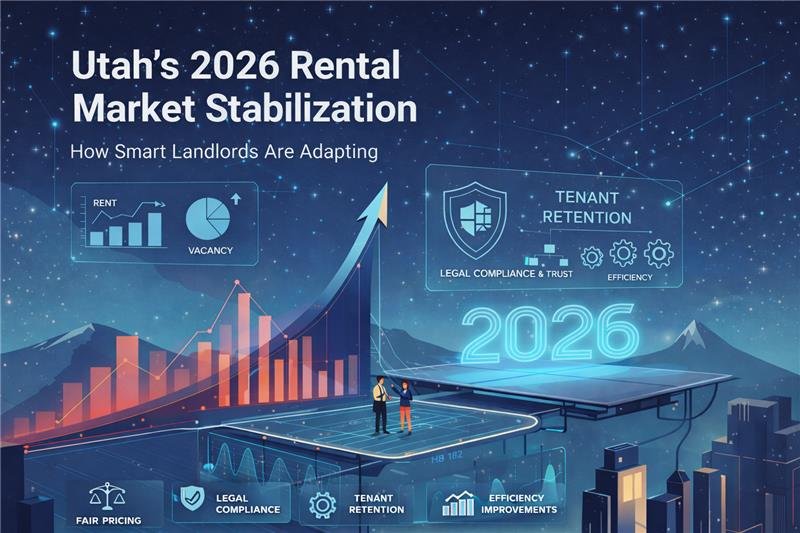
The Utah rental market has shifted from a landlord’s market (2021-2024) to a stabilized environment in 2026, requiring a proactive and strategic approach to property management.
Understanding Utah's Market Stabilization Factors
Several key factors contribute to the current market stabilization, shifting the dynamics from a landlord-favored environment to one requiring more strategic navigation. This isn’t a crisis, but a necessary correction demanding adaptability.
- Supply Surge: Multifamily construction projects from 2022-2024 are now delivering units, significantly increasing inventory and competition.
- Cooling Rents: Salt Lake County has seen a 3.2% dip in average rents since July 2025, with similar downward pressure in Davis and Utah counties. This is a noticeable decline, not just a plateau.
- Concession Mania: Landlords are offering incentives like free first month’s rent, reduced security deposits, and multiple months of free rent to attract tenants, maintaining apparent stable base rents.
- Extended Vacancies: Units are now vacant for weeks instead of days. Statewide vacancy rates have risen from below 4% to above 7% in many areas, with new Salt Lake City apartments and Utah County particularly affected.
- Tenant Leverage: Renters now have more power, are more discerning, and actively seeking the best deals and terms available.
Projected Outlook: The Kem C. Gardner Policy Institute anticipates this supply surge to be temporary. Rents are expected to resume an upward trend by late 2026 to early 2027 as construction slows and demand catches up.
New Competitive Advantages for Landlords
In the current market, a superior tenant experience, smart pricing, and operational efficiency are paramount for success.
✦Tenant Experience is King
- Maintenance: 24-48 hour response time is the expectation, with AI-powered triage recommended for efficiency.
- Communication: Proactive, regular communication, and digital portals for rent/maintenance are standard.
- Long-Term Focus: Initiate lease renewal conversations 90 days in advance to foster loyalty.
✦Smart Pricing for Occupancy
- Occupancy Over Peak Rates: Maintaining occupancy at a slightly lower rent (e.g., $50 below peak) is more advantageous than enduring vacancy.
- Lease Renewal Incentives: Offering incentives for renewals is more cost-effective than tenant turnover.
- Transparency: Clear and transparent fee structures build trust.
✦Operational Efficiency
- Speedy Screening: Respond to applicants within 48 hours; top-tier tenants won’t wait.
- Seamless Showings: Professional presentations and same-day scheduling for first impressions.
- Smooth Moves: Ensure a seamless move-in experience.
Real Scenario Example
A Rentomatic client with three Sandy properties maintained 100% occupancy in 2025 by pricing units $75 below peak market rates and offering existing tenants $200 lease renewal credits.
$3,300 Annually: Cost of incentives.
$18,000 Annually: Estimated cost of 3 months combined vacancy and turnover.
This strategic approach led to significant annual savings.
Boom vs. Stabilized Market Strategies Comparison
| Strategy | Boom Market (2021-2024) | Stabilized Market (2026) |
|---|---|---|
| Pricing approach | Push rents to maximum | Competitive retention pricing |
| Vacancy tolerance | Fill within days | Strategic concessions needed |
| Tenant retention | Low priority | Critical cost savings |
| Maintenance response | Reactive acceptable | Speed creates competitive advantage |
| Property management | Optional luxury | Professional edge |
New Utah Disclosure Laws: Compliance as a Competitive Edge
Navigating regulatory changes is crucial. Utah HB 182 from the 2025 General Session, titled “Rental Amendments,” took effect on May 7, 2025, and significantly impacts landlords.
- Pre-Payment Transparency: Written disclosures are mandatory before accepting any payment, covering estimated rent/fees, screening criteria, unit availability, and refund policies.
- Electronic Deposits: Security deposits can be returned electronically with tenant consent.
- Post-Eviction Access: Tenants have 5 business days to retrieve essential belongings after an eviction.
- Rent Increase Notices: Rent hikes exceeding 10% require at least 60 days’ notice (with exceptions).
- Late Fee Limits: Late fees are capped at 10% of rent or $75 (whichever is greater), with restrictions on unspecified fees.
- Property Condition Inventory: A written inventory or walkthrough of the unit’s condition must be provided before lease commencement.
Competitive Advantage of Compliance: Adhering to these laws builds trust and credibility, reducing risks of legal repercussions, fines, and reputational damage.
The Economics of Tenant Retention
Tenant turnover is exceptionally costly, making retention a critical strategy in a stabilized market.
◆Cost of Turnover (Estimated)
- Lost Rent: $2,000-$3,000 per turnover (30-45 days vacancy).
- Cleaning & Repairs: $800-$1,500.
- Marketing & Showing: $200-$400.
- Screening & Processing: $100-$200.
- Total Estimated Cost: $3,100-$5,100 per unit (average $3,872 in 2023-2025).
◆Smart Retention Strategies
- Early Bird Renewals: Initiate discussions 90 days prior to lease expiration.
- Modest Increases: 2-3% increase for reliable tenants beats higher increases and subsequent vacancy.
- Show Appreciation: Regular maintenance improvements foster loyalty.
- Responsiveness: Prompt and courteous communication is vital.
Example Scenario: Gain vs. Loss
Property Manager A loses a tenant by raising rent $200/month, incurring $4,500 in costs. Property Manager B retains a tenant with a $50/month increase and a $150 renewal credit.
Manager A: -$4,500 (lost rent & turnover costs).
Manager B: +$4,950/year (net gain per unit).
Proactive retention yields significant financial benefits.
Rentomatic's Stabilization Strategy
Rentomatic offers a comprehensive strategy for 2026 success, integrating market insight, tenant focus, and operational excellence.
- Quarterly rent analysis
- Occupancy-first recommendations
- Automated 90-day outreach
- Proactive maintenance
- HB 182 disclosure management
- Automated deposit returns
- 48-hour maintenance response
- Digital showing schedulers
Conclusion: Adapt Now, Dominate Later
Utah’s rental market stabilization is a selective process that distinguishes dedicated professionals from casual players. Savvy landlords view this as an opportunity to build lasting competitive advantages through tenant retention, operational excellence, and legal compliance.
Those who adapt now will be positioned for significant success when the market regains its growth momentum in late 2026-2027.