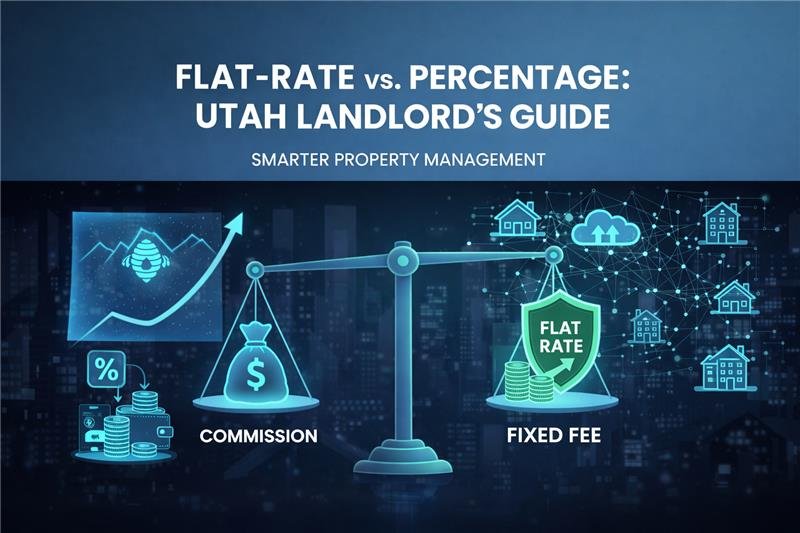
This blog post, dated 2026, discusses the evolving landscape of property management fees for Utah landlords, focusing on the rise of flat-rate models as a challenger to the traditional percentage-based commission. As Utah’s rents have increased, so have commissions, leading landlords to question the proportionality of fees to workload.
The Traditional Percentage-Based Fee Model
The percentage-based model, typically 8-12% of gross monthly rent, has been the industry standard for decades.
- Historical Context: Property management formalized in the early 20th century, particularly after the Great Depression, to manage foreclosed properties.
Rationale: Designed to align property manager incentives with landlords by having managers earn more when rents are higher, theoretically motivating them to secure better tenants and maximize income.
Practical Application & Escalation:
- \$1,500 rent = \$120-\$180/month commission
- \$2,500 rent = \$200-\$300/month commission
- \$3,500 rent = \$280-\$420/month commission
“Effort vs. Pay” Controversy: Landlords often find that the property manager’s workload (tenant screening, routine maintenance, property management) does not increase proportionally with rising rents. Managers’ pay increases due to market forces, not necessarily increased effort.
Hidden Costs: Percentage models can lead to additional fees for leasing, inspections, or maintenance markups, eroding profitability and transparency. While Utah law aims to prevent hidden fees, landlords must ensure contract transparency.
The Flat-Rate Property Management Model
Premise: A fixed monthly charge is applied, irrespective of the rental income.
Rise of the Model: Gained momentum after the 2008-2010 real estate crash, favored by investors with high-end (“Class A”) properties for its predictability and control.
Predictability & Budgeting: Offers consistent, predictable costs, simplifying budgeting, especially for landlords with high-rent units or multiple properties.
Cost-Effectiveness:
- More cost-effective for high-rent properties.
- Potentially less economical for very low-rent units (e.g., a \$125 flat fee on a \$1,000 rent is an effective 12.5%).
- Significant savings are possible in the Utah market due to relatively high rents.
Controversies & Caveats:
Incentive Debate
Concerns that flat fees might reduce motivation to maximize rent or minimize vacancies, as compensation is static.
“Nickel and Dime” Risk
Some companies may use low “teaser rates” and then add numerous fees. Thorough due diligence and transparency are crucial.
Service Quality
Concerns about potentially less personalized attention if managers handle larger portfolios under a flat-rate model.
Financial Benefits for Multi-Property Utah Landlords
Utah’s rising rents and competitive market amplify the financial impact of percentage fees. Savings compound significantly with more properties.
Example Comparison (Rent: \$2,200/month, Flat-Rate: \$100/property):
| Properties | Percentage (10% Annually) | Flat-Rate (Annually) | Annual Savings |
|---|---|---|---|
| 2 Properties | \$5,280 | \$2,400 | \$2,880 |
| 3 Properties | \$7,920 | \$3,600 | \$4,320 |
| 5 Properties | \$13,200 | \$6,000 | \$7,200 |
| 10 Properties | \$26,400 | \$12,000 | \$14,400 |
Bottom Line Impact: A landlord with five properties could save over \$7,200 annually by switching to a flat-rate model.
"Full Service" with Quality Flat-Rate Management
Reputable flat-rate companies should offer comprehensive services without compromise.
- Rigorous tenant screening and placement
- Efficient rent collection and transparent accounting
- Prompt maintenance coordination (without markups)
- Expert legal compliance (evictions, lease agreements)
- Regular property inspections
- Robust financial reporting
Key to Quality: Achieved through efficiency and technology, not by cutting corners.
Future Trends in Property Management
Technological Advancements
- AI & Automation: Streamlining tenant screening, maintenance scheduling, and communication; predictive analytics for maintenance.
- IoT & Smart Buildings: Remote monitoring for HVAC and security, enabling energy optimization.
- Cloud-Based Systems: Centralized platforms for owners and tenants, enhancing transparency and collaboration.
- Data-Driven Decisions: Optimizing rental yields and market trend prediction.
Market Evolution & Regulatory Environment
- Increased focus on tenant experience and retention.
- Growth of remote management via cloud solutions.
- Emergence of hybrid fee models (flat rate + performance incentives).
- Regulatory Environment: Ongoing discussions in Utah regarding potential changes to property manager licensing requirements.
Rentomatic: A Leading Flat-Rate Provider in Utah
Discover why Rentomatic stands out in the Utah property management market.
Cloud-based transparency
Real-time reporting and owner portals for complete visibility.
Tech-driven efficiency
Automation reduces overhead, passing savings to clients.
Customer-focused
Prioritizes tenant retention and landlord satisfaction.
Flexible service packages
Tailored to diverse portfolio needs and landlord requirements.
Conclusion: Protecting Profits with Flat-Rate Management
The shift to flat-rate property management is presented as a fundamental change for astute landlords to safeguard profits. For those with multiple properties or premium rentals in Utah, it offers significant annual savings.
The blog emphasizes taking control of finances and ensuring management fees align with value received. A call to action directs readers to Rentomatic’s pricing for potential savings calculations.